Advertising measurement
Spending More on Ads but Getting Fewer Orders? Audit Tracking
Tracking can be incomplete, duplicated or misattributed, but it is not the automatic cause of higher acquisition cost. Reconcile business outcomes with event delivery, consent and platform reporting before changing campaigns or promising that server events will fix them.
Reviewed October 8, 2026 against current Meta and Google guidance.

Hassan Jamal·Published ·Updated ·12 min read
Separate four questions
- ✓Did the business event actually happen in the system of record?
- ✓Was an eligible, consented event sent from the browser, server or both?
- ✓Did the platform receive, match, deduplicate and accept it?
- ✓How did the selected attribution model report and use it?
Truth
Order, lead, refund and value in the source system.
Delivery
What the browser and server send, when they send it, and whether delivery fails.
Reconcile
Coverage, duplicates, match and attribution.
Govern
Consent, purpose, minimization, access and retention.
1. Diagnose the business result before the tracking stack
A lower platform-reported conversion count can reflect fewer orders, a measurement gap, an attribution change, or more than one at once. Do not treat the ad dashboard as the system of record for fulfilled commerce. Two things in particular are worth ruling out before anyone quotes you for tracking work: the auction moved, and the creative fatigued. Either can raise your cost per order while your account, your site and your measurement all sit unchanged.
- ✓Confirm orders, paid revenue, cancellations, refunds and contribution margin.
- ✓Compare spend, impressions, clicks, landing sessions and product availability.
- ✓Review creative, audience, bidding, campaign structure and market changes.
- ✓Inspect landing, product, cart and checkout conversion by device and source.
- ✓Check pricing, shipping, promotion, payment and site-error changes.
The test that splits this in one sitting. Count the orders in your own system of record (the store admin, the ERP, the payment processor) for an exact date range, then compare that count against what the ad platform reports as conversions for the same range and the same campaigns. If real orders held steady while platform-reported conversions fell, you have fewer recorded orders, not fewer orders, and the problem is measurement. If real orders genuinely fell, the tracking stack is not your first problem and nothing on the rest of this page will fix it. Run this before paying anyone to touch your pixel, because the two answers send you to completely different work.
That distinction is missing from most advice on this symptom. The usual explanations (audience saturation, creative fatigue, broad or colder targeting as budget rises, and disrupting the learning phase by scaling too fast) are all real, all common, and all assume the orders genuinely are not happening. They are the right answers to a demand problem. None of them can explain a case where the orders arrived, the money cleared, and the platform simply never heard about it. That case looks identical from the ad dashboard, and it is the one this page is about.
Two of those causes deserve naming, because they are common and neither one is your tracking. The first is the auction. What you pay is set partly by how many other advertisers are bidding for the same attention this month, so your cost per order can rise while your account, your site and your measurement all sit unchanged. Seasonality and a competitor deciding to spend do that to you. The second is creative fatigue. The same audience seeing the same ad for the seventh time responds less, and that shows up as rising cost per result rather than as anything obviously broken. Both are worth ruling out before anyone quotes you for tracking work, because neither is fixed by better measurement.
A lower platform-reported conversion count can reflect fewer orders, a measurement gap, an attribution change or more than one at once. Do not treat the ad dashboard as the system of record for fulfilled commerce. For the event-path side of the same investigation, work through diagnosing a Meta tracking data path.
2. Define the event contract
Every definition in this table has an evidence column, because a contract nobody can test is not a contract. Six fields have to be written down before anyone builds: what the event is, which identifiers are permitted, how value is counted, what consent state is required, how duplicates are collapsed, and who owns it. The deduplication row is where most implementations quietly double-count.
| Field | Definition | Acceptance evidence |
|---|---|---|
| Event | Business action and trigger | Test order or lead tied to the source record |
| Identity | Permitted identifiers and normalization | Platform diagnostics without exposing raw data |
| Value | Currency, gross or net value and refund treatment | Matches the approved finance definition |
| Consent | Required state and regional policy | Pre-consent, accept, reject and revoke tests |
| Deduplication | Shared stable event identifier and rule | One accepted business event, not two counted copies |
| Ownership | Business and technical owners | Runbook, access and change approval |
Broken tracking is not the automatic explanation for rising acquisition cost. It is one hypothesis to test, not a conclusion.
3. Reconcile coverage instead of assuming a fixed loss rate
For each eligible event in the system of record, check browser delivery, server delivery, platform receipt and reported attribution. Segment by consent state, browser, device, market, payment method and implementation version. Exclude test, cancelled and refunded events according to the approved definition.
We do not publish a single share for how much conversion data browser tracking misses. That share depends on your consent rates, browser and device mix, markets, payment methods and implementation version, and it shifts with every release, so a figure stated without a sample and a reconciliation method is not one you should plan against. Reconcile your own eligible events against platform receipts, segment the gap, and treat rising ad cost as a separate question until your own reconciliation shows what is actually missing.
4. Use Meta Pixel and Conversions API deliberately
Meta recommends Conversions API alongside the Pixel when events are shared from a website. Meta offers partner, gateway and manual setup paths. The right path depends on required events, systems, consent, data policy, infrastructure and operating ownership. What each path involves as a piece of work is broken down in our guide to a server-side Conversions API build.
- ✓Send only permitted fields required for the documented purpose.
- ✓Normalize and protect identifiers according to current platform requirements.
- ✓Deduplicate browser and server copies of the same business event.
- ✓Test timestamps, currency, value, source URL and action source.
- ✓Monitor rejected, delayed, duplicated and malformed events after releases.
- ✓Rotate credentials and restrict access to the smallest operational group.
Is Meta's free Conversions API enough on its own?
Meta announced a Meta-enabled Conversions API on April 15, 2026 as a one-click option. Check availability for your account before commissioning custom work. The announcement does not by itself verify the payload, matching or deduplication for your business events.
Test eligible setup options in Events Manager against your event requirements. Reconcile transactions and inspect matching and deduplication. If a requirement remains unmet, record that gap before pricing a partner or custom integration. Do not assume that a server-side connection automatically repairs incorrect source data or covers subscription and offline events.
On the numbers Meta publishes alongside it, its April 15, 2026 announcement states that “advertisers with a Conversions API setup for web events saw an average 17.8% lower cost per result compared to those without Conversions API”. Read that as Meta's own figure comparing two groups of advertisers, not as a before-and-after on a single account, and not as something you should write into a forecast. Advertisers who have implemented server-side tracking differ from those who have not in more ways than the tracking.
5. Treat Event Match Quality as a diagnostic
Platform diagnostics can show whether identifiers and event parameters are useful for matching. They do not directly set an advertiser's cost or prove incremental return. Improve missing or invalid fields only when collection and use are permitted, then evaluate measurement and campaign outcomes separately.
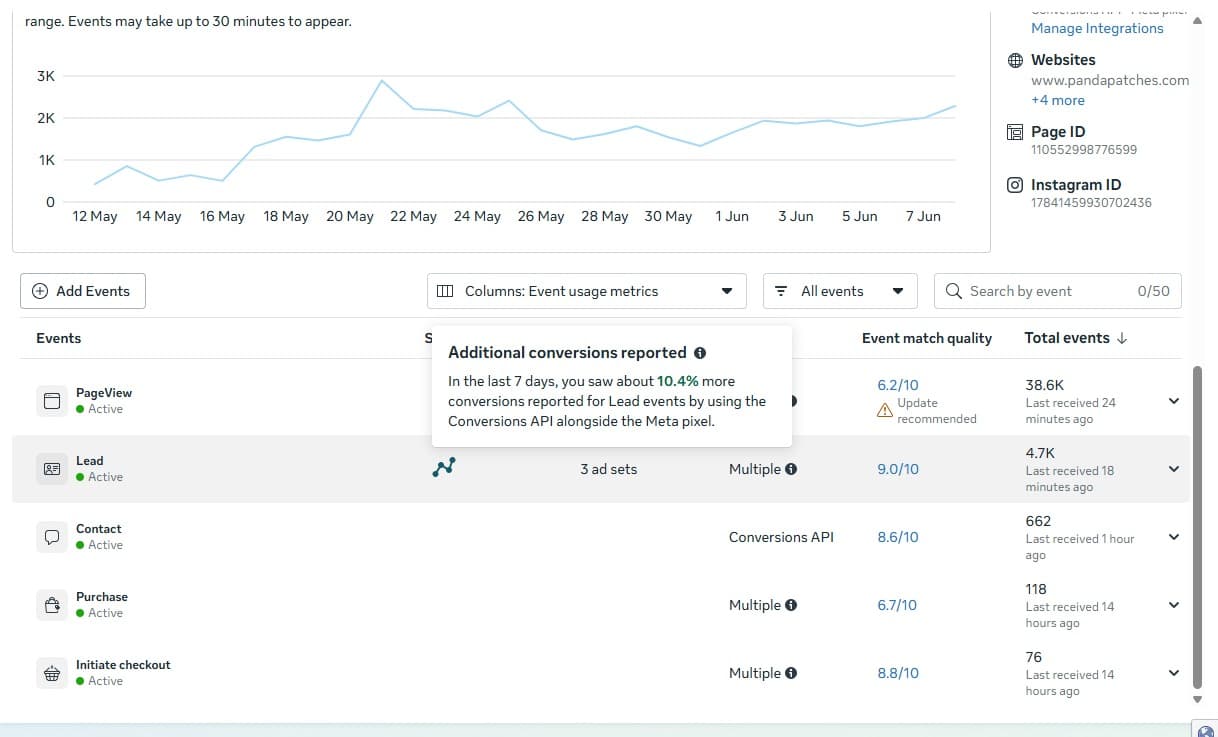
These are first-party captures from Panda Patches, which is owned by a PandaCodeGen co-founder, so treat them as our own operating evidence rather than an independent client result. They show what Meta reported for one account over one short window. A ~10% difference in reported Lead conversions is a measurement change, not proof that 10% more leads existed, and not a forecast for your account. Event Match Quality is a matching diagnostic: a 9.0 on Lead and a 6.7 on Purchase in the same account is the useful signal, because it points at which event is missing parameters. Your own numbers depend on your traffic, consent rates and which identifiers you are permitted to collect and send.
6. Implement Google enhanced conversions under current rules
Google describes enhanced conversions for web as supplementing existing conversion tracking with hashed first-party customer data. In April 2026, Google began unifying the web and lead settings while continuing to support tag, Data Manager and API inputs. Verify the current account setup rather than following an older screenshot tutorial.
7. Make consent behavior testable
Google's current consent guidance requires the default state to be set before measurement commands and updated when the user makes or changes a choice. The organization remains responsible for its policy, legal basis and regional configuration. Server delivery does not bypass consent or data-protection obligations.
- ✓Test first visit before any choice.
- ✓Test granular acceptance and rejection.
- ✓Test preference persistence across pages and return visits.
- ✓Test revocation and deletion or suppression workflows.
- ✓Inspect actual network and server behavior, not only the banner UI.
8. Keep AI discovery outside the ad-tracking claim
Product feeds, structured data and crawlable content can help eligible discovery systems understand products. That is a different system from Meta or Google Ads event delivery. A clean ad-event implementation does not guarantee an AI recommendation, citation or attributed sale. We treat that as a separate subject in how agentic browsers read a page and in our review of Google's Universal Commerce Protocol.
9. Compare implementation paths on total operation
Compare the four routes on what it costs to operate, not on what it costs to set up. Native and partner integrations reduce custom work and bring their own supported scope and recurring charges. A gateway centralizes delivery and adds infrastructure you now run. A direct integration gives you control and hands you credentials, monitoring and API-change ownership. An agency implementation is only comparable once you know which events, tested how, documented where, and owned by whom.
- ✓Native or partner integration: supported scope, setup, recurring cost, data path and limits.
- ✓Gateway or managed server tagging: hosting, configuration, support, data path and exit.
- ✓Direct integration: engineering control plus credentials, monitoring, maintenance and API change ownership.
- ✓If an agency implements it: which events you agreed, which systems, how consent is handled, how it was tested, what is documented, what support you get, and who owns it.
Server-side advertising events can be included when the accepted project scope names the events, systems, consent behavior and acceptance evidence. They are not automatically included in every website tier, and PandaCodeGen does not promise an attribution, ROAS or revenue lift. Scope is defined in the proposal for e-commerce development or custom engineering, and the tiers are listed on the pricing page.
Why bolt-on tracking keeps breaking
There is a pattern worth recognizing, because it decides whether you are buying a fix or renting one. When tracking lives in an app or a tag layered on top of a platform you do not control, a change to that platform can take your measurement with it. Shopify's removal of checkout.liquid is the clearest recent example: stores that had been passing customer details to their tracking scripts from those pages stopped passing them, match quality fell, and nobody at those businesses had touched anything. Shopify's own documentation states it plainly: “Script tags were sunset on those pages on August 28, 2025 for Plus stores, and are sunset for non-Plus stores on August 26, 2026.”
That non-Plus date was 26 August 2026 and it has passed. If any of your Meta, Google or analytics measurement still ran through a script tag on the Thank you or Order status pages, it has already stopped, and nothing at your business will have changed to explain it. That makes this the first thing to rule out if your numbers moved in September: open Shopify admin, check what is still installed on those pages, and move it now rather than spending the week diagnosing a platform change as a campaign problem.
This is not an argument that tracking apps are bad. Most of them do what they say. It is an argument about where the thing sits. An app treats the symptom perfectly well while the underlying condition, that you do not control the layer your measurement depends on, stays exactly as it was. That is worth knowing before you choose between renting the fix and owning it, and it is a different question from whether your tracking is currently broken.
10. Require acceptance evidence
An implementation is accepted on artifacts, not on assurances. Six of them prove it works: a reconciliation against the source of truth for a defined period, browser and server traces with sensitive values redacted, deduplication and refund tests, platform receipts tied to named test events, results across consent states and regions, and a runbook naming owners and alerts. Ask for them before the invoice, not after.
- ✓A source-of-truth reconciliation for a defined test period.
- ✓Browser and server event traces with sensitive values redacted.
- ✓Deduplication, currency, value, refund and repeated-event tests.
- ✓Platform receipt and diagnostic screenshots tied to named test events.
- ✓Consent-state, browser, device and regional test results.
- ✓Runbook, owners, credentials, alerts and post-release monitoring.
Where a business needs its own view of that reconciliation rather than a vendor dashboard, the operations dashboards we build show one approach, and the rest of our client work covers the storefronts around them. What transfers to you at handover is set out in who owns your website. To review a specific account, get in touch.
Tell us what you have
We will map the system of record, browser and server events, consent, platform diagnostics and operating ownership before scoping a tracking repair or storefront migration.
Primary sources
- Meta: set up and install the Meta Pixel
- Meta Business Tools overview
- Meta data-processing terms
- Meta: about Event Match Quality
- Google Ads: enhanced conversions for web
- Meta announcement: Pixel and Conversions API updates (April 15, 2026)
- Shopify: checkout.liquid and script tag sunset dates
Questions & answers
Frequently Asked Questions
Why are my ad costs going up but my orders staying flat?
What is Event Match Quality (EMQ) and why does it matter?
Do Google and AI shopping also need this kind of tracking?
How much does server-side tracking cost if I add it to my platform store?
Why does a custom-coded site handle ad tracking better than a platform store?
Is this tracking setup included in a PandaCodeGen build?
Related Articles
Meta Ad Tracking Not Working? A 2026 Diagnostic Guide
A consent-aware method for reconciling orders and Meta events, debugging browser and server delivery, and preventing duplicate events.
Meta Conversions API Setup Cost: A Scope-Based Guide
Plan Meta Conversions API cost from events, systems, consent, matching, deduplication, QA and monitoring, with a carefully labelled Panda Patches screenshot.
WooCommerce Low Conversion Rate: Diagnose It Before You Blame Speed
Speed is the usual suspect because it is the easiest thing to have an opinion about. A diagnostic order that finds the funnel stage which actually changed, including the problems WooCommerce creates that no hosted platform does.