
Panda Patches.
$50K/mo. $55 in tooling.
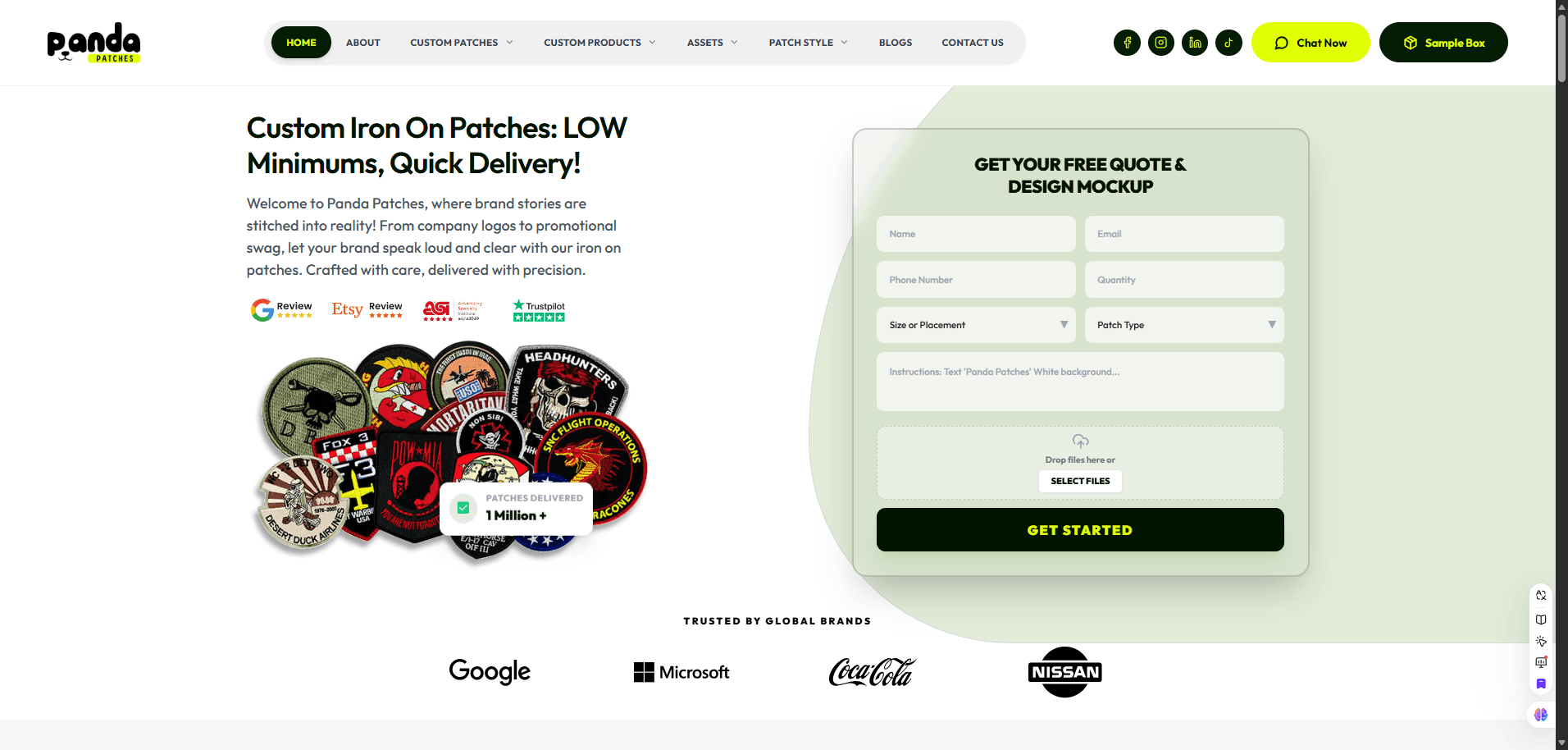
A 3-year-old WordPress e-commerce site with real search traffic, existing customers, and a pricing problem WordPress couldn't solve. We rebuilt the storefront with Next.js, Sanity, Supabase and a custom pricing calculator, connected to a separate operations platform. Panda Patches started with Stripe. We later moved its payments to Square, which is the current provider. No ranking losses were recorded in Google Search Console during the 30-day post-launch monitoring window. Revenue has scaled from $38K to about $50K/month on about $55/month in total tooling costs (Supabase ~$25, Vercel ~$20, and ~$10 for the FAL Flux Schnell AI patch generator).
Ownership disclosure
Panda Patches is an in-house brand and the founders’ first business, trading since 2023. It is owned and operated by PandaCodeGen co-founder Imran Raza Ladhani, who holds a stake in both companies; PandaCodeGen built and maintains its technical platform. The two businesses therefore share an owner, and nothing here is arm’s length. Treat the figures below as owner-reported first-party records from a founder-owned business, not an independent client testimonial or a controlled study.
Not a portfolio piece. A business that has shipped 1,000,000+ patches.
The platform we built runs a real, high-volume manufacturing business that has delivered custom patches to teams at some of the world's biggest brands.
16,000 patches for Wise's Nasdaq Times Square activation
Designed, approved, and delivered in under two weeks to hit a Nasdaq listing date that could not move, ordered, produced, and tracked through the platform.
Read the Wise case study →Rated 4.8/5 by 72+ customers on Trustpilot
1,000,000+ patches delivered, with 5-piece minimums, mockups in 12 to 24 hours, and a money-back guarantee, all transacted through the custom storefront.
The storefront today, in production.
What started as a WordPress migration is now a deep custom storefront on Next.js 16 + React 19, with an AI generator, a customer portal, and a full conversion-tracking stack. The staff side, order operations, production, and reporting, runs in a separate connected CRM that shares the same Supabase backend.
3 years of SEO equity. Zero ranking drops.
Migrating a 3-year-old WordPress site is the hardest part of any replatform. The site had existing Google rankings, backlinks, and organic traffic that the business depended on. A broken migration kills all of that overnight. Here is exactly what we did to preserve 100 percent of the search equity.
Full URL audit before migration
We exported every indexed URL from Google Search Console and mapped each one to its new equivalent on the Next.js site. Zero orphan pages.
301 redirects for every old URL
Every WordPress URL gets a server-side 301 redirect to the matching Next.js page. Old product URLs, old blog posts, old category pages, everything. Configured in Next.js middleware.
Meta titles and descriptions preserved
We carried over the exact meta titles and descriptions from the WordPress site where they were already ranking. No rewriting. No experiments during migration.
Schema markup upgraded, not replaced
The old site had basic schema. We replaced it with a complete @graph structure (Article, Product, BreadcrumbList, Organization, FAQPage) without changing the existing entity signals Google already trusted.
New XML sitemap submitted day one
A fresh sitemap.xml with all new URLs submitted to Google Search Console immediately after launch. Google started recrawling within hours.
Core Web Vitals improved, not regressed
Load time dropped from 4+ seconds on WordPress to under 1 second on Next.js. Google rewarded the improvement with better rankings, not worse.
The result: zero ranking drops in Google Search Console
We watched Search Console daily for 30 days after launch. Every ranked keyword held position. No 404 spikes. No sudden impression drops. No manual actions. After 60 days, rankings actually improved because the new site loads in under 1 second, which Google rewards under its 2026 Core Web Vitals algorithm. This is exactly how a WordPress to Next.js migration should go.
WordPress couldn't quote a price.
✕No Calculator. Every Sale Was a Waiting Game.
Custom patches have complex pricing. The final price depends on patch type (9 options), size, quantity, backing, and border. That's thousands of combinations. WordPress had no way to calculate this live. So every customer filled out a contact form and waited 24+ hours for someone to manually work out a price and email it back. Most of them didn't wait — they went to a competitor who showed them the price instantly.
✕7 Disconnected Tools
The business ran on: WordPress for the store, a separate CRM, Google Sheets for order tracking, a spreadsheet for attendance, and WhatsApp for team updates. 7 team members touching 5 different tools with zero real-time sync. Every status update was a manual message.
An instant business calculator. Pick your options, see your price.
We built a custom quote calculator directly into the storefront. Customers select patch type, enter their dimensions, choose quantity and finish options — and the exact price appears instantly. No forms. No waiting. No back-and-forth emails. The calculator is the checkout. What used to take 24 hours now takes 30 seconds.
Embroidered, Woven, PVC, Chenille, Leather, Silicone, Printed, Sequin, 3D
Lapel Pins, Challenge Coins, Keychains, PVC Shoe Charms
Iron-On, Velcro, Peel & Stick
Merrowed, Hot-Cut
Custom dimensions with real-time price update
Volume discounts auto-calculated per order
The pricing engine calculates live
9 patch types × custom dimensions × 8+ quantity tiers × 3 backing options × 2 border types = thousands of price combinations. All calculated client-side with a custom TypeScript pricing engine. Zero API calls per keystroke. Response time: <5ms.
Far past a migration. A conversion machine.
The storefront kept growing after launch. Panda Patches started with Stripe. We later moved its payments to Square, which is the current provider. Today the site includes an AI mockup generator, checkout with installment options, a customer portal for reorders and server-side conversion tracking.
We integrate Stripe, Square and other payment providers with your checkout and order workflow. We confirm provider availability, API access and the features you need before agreeing the scope.
AI Patch Generator
Branded “Panda AI” — a FAL-powered mockup generator with no signup required, a shape/style prompt pipeline, 120+ abuse-blocking rules (trademarks, logos, hate symbols), 30-day artifact TTL, and a clean handoff straight into the order flow.
Customer Portal
Supabase-auth accounts auto-provisioned on first paid order: dashboard, order history, tracking, and one-click re-priced reorder with loyalty pricing.
Square Checkout + BNPL
Hosted Square Payment Links: card, Apple Pay, Google Pay, Cash App Pay, and Afterpay 'pay in installments.' Server-side re-pricing blocks tampering.
Conversion & Attribution
Meta Pixel + CAPI (deduped via shared eventID), GA4/GTM, Google Ads, Pinterest, Bing UET, and an OpenAI pixel, with fbp/fbc/gclid/UTM re-derived server-side on every order.
Offers & Bulk Ordering
Fixed-price /offers packs with inline multi-step checkout, volume-tier bulk pricing, and a two-stage abandoned-cart recovery sequence (30 min, then 24 h with a code).
SEO / AEO Surface
180+ indexed pages: a 63-post blog, US state & city location pages, product-category and competitor-comparison pages, partner & offers pages, and an /ai-info answer hub with topic cluster pages, all backed by llms.txt, JSON-LD, hreflang (US/UK/CA/AU), dynamic sitemap/robots, and IndexNow pinging.
One backend. The whole business runs on it.
Beyond the storefront, we built the staff side too: a separate Supabase-backed CRM that replaced the old CRM, Google Sheets, attendance tracker, and WhatsApp update chains. It shares the same backend as this storefront, so leads, quotes, orders, and payments flow straight in. 7 team members, one source of truth, every change logged with a timestamp and author.
Read the full CRM case study →Order Pipeline
Every order from storefront to production to fulfillment in one real-time view. Status updates trigger automatically.
Sales Agent Dashboard
7 sales reps tracked individually. Revenue, conversion rate, quote volume, and response time per agent.
Employee Clock In/Out
Replaced WhatsApp updates. Timestamped, geofenced clock-in system with automated payroll export.
Role-Based Access
Admins see everything. Sales agents see their pipeline only. Production sees pending orders. Zero data leakage.
Team Performance
Every change is logged. Manager sees who updated what, when. Full audit trail for accountability.
Single Source of Truth
One Supabase database feeds the storefront, ops portal, and admin panel. No duplicate entries, ever.
Enterprise architecture. Startup cost.
Started free on Vercel. Scaled to $20/mo on Vercel Pro once the store hit $38K/mo in revenue; it has since scaled to about $50K/mo. Sanity and Cloudflare still run on free tiers. Total tooling: about $55/mo (Supabase ~$25, Vercel ~$20, and ~$10 for the FAL Flux Schnell AI patch generator).
What changed after launch.
3 years of WordPress SEO equity at risk
No ranking losses recorded in Search Console across the 30-day post-launch window.
Customers waited 24+ hours for a manual quote
Customers see the price instantly. Self-serve checkout.
$200+/mo across 3 separate tools + hosting
About $55/mo total (Supabase ~$25, Vercel ~$20, and ~$10 for the FAL Flux Schnell AI patch generator). CRM, ops, store, and hosting.
7 disconnected tools, constant WhatsApp updates
1 platform. All 7 team members on the same real-time data.
WordPress pricing ceiling blocked growth
Scaled from $38K to about $50K/mo revenue. Pricing engine scales to any complexity.
Attendance tracked via WhatsApp messages
Timestamped clock in/out with payroll export.
No visibility into sales agent performance
Per-agent revenue, conversion rate, and response time tracked live.
Load time over 4 seconds on WordPress
Under 1 second load time. Lighthouse 90+ on Core Web Vitals.
What this actually meant for the business.
This is a founder-affiliated project, not an independent client engagement. Panda Patches is owned and operated by PandaCodeGen co-founder Imran Raza Ladhani. PandaCodeGen built and maintains its technical platform, and its co-founder Imran Raza Ladhani holds a stake in both companies, so the two businesses share an owner and this is not an arm’s-length relationship. We built the technical platform and the business runs on it. These are first-party operating figures reported by the owner, not projections and not independent client proof.
Scaled from $38K to about $50K/mo. A patch business running on custom Next.js + a bespoke ops platform. No Shopify cut. No app fees. No platform holding the business hostage.
WordPress and WooCommerce, a separate CRM, Google Sheets for order tracking, an attendance tracker, and WhatsApp for team comms, all replaced by one custom platform built exactly for how this business actually operates.
The entire tech stack — storefront, ops dashboard, email, hosting, AI patch generator — costs about $55 a month to run (Supabase ~$25, Vercel ~$20, and ~$10 for the FAL Flux Schnell AI patch generator). The revenue it processes has scaled from $38,000 to about $50,000.
Everything that was built.
The method behind this, written up
The reasoning behind each decision in this build is documented in the guides, if you want the method rather than the result:
- Next.js and Sanity: fit, cost and tradeoffs — the CMS pairing this storefront runs on, including where it is the wrong choice.
- Will migrating hurt my SEO? — what actually causes ranking loss in a move, and what preserved the equity here.
- WordPress versus custom code over three years — the cost model behind replacing a platform that could not quote a price.
- Build versus buy for business software — the decision that produced the operations layer rather than another subscription.
Want results like this?
Frequently Asked Questions
Did the Panda Patches WordPress migration preserve Google search rankings?
We migrated the 3-year-old WordPress site to Next.js and recorded no ranking losses in Google Search Console during the 30-day post-launch monitoring window. We exported every indexed URL before migration, built 301 redirects for each one in Next.js middleware, preserved existing meta titles and descriptions, upgraded schema markup without changing entity signals, and submitted a fresh sitemap to Google the day of launch. Rankings held through that 30-day window. Movement after that point reflects many factors outside our control and is not attributed to the rebuild. No provider controls search rankings.
Can you replace Shopify with a custom coded e-commerce store?
Yes, but this project is not the evidence for it. Panda Patches ran on WordPress and WooCommerce and was never on Shopify, so it shows we can replace a WordPress commerce stack with a custom Next.js storefront, not that we have moved a store off Shopify. The current platform uses Sanity, Supabase and Square. Panda Patches started with Stripe. We later moved its payments to Square, which is the current provider. For a Shopify store there are two different jobs: a headless storefront that keeps Shopify running products, orders and payments, or a full replacement of commerce as well. We scope those separately. Panda Patches is founder-affiliated, not an independent client engagement.
How does a real-time pricing calculator work without API calls?
We built the pricing engine in TypeScript and run all calculations client-side. The full pricing matrix, 9 patch types, custom dimensions, 8+ quantity tiers, 3 backing options, 2 border types, is pre-compiled into a JavaScript function. Every price update takes under 5ms with zero server round-trips.
How much does it cost to build a custom e-commerce platform like this?
A custom e-commerce platform with a real-time pricing engine, CMS, Square checkout (card, Apple Pay, Google Pay, Cash App Pay, and Afterpay BNPL), an AI mockup generator, a customer portal, and a full server-side conversion-tracking stack starts at $15,000 to $30,000 depending on complexity. Panda Patches runs on about $55/month in total tooling costs after launch (Supabase ~$25, Vercel ~$20, and ~$10 for the FAL Flux Schnell AI patch generator).
What tools did the custom platform replace?
One platform replaced: WordPress + WooCommerce ($80/mo), a separate CRM ($50/mo), Google Sheets for order tracking, a manual attendance tracker ($30/mo), and WhatsApp for team communication. Total savings: $200+/month plus 10+ hours per week of manual work.
How long did it take to build the Panda Patches platform?
The initial storefront rebuild launched within 8 weeks. Panda Patches started with Stripe. We later moved its payments to Square, which is the current provider. The current storefront includes custom pricing, Sanity CMS, an AI patch generator, a customer portal and server-side conversion tracking; the current feature set should not be read as the original launch scope. The connected staff CRM is a separate application sharing the same Supabase backend.